


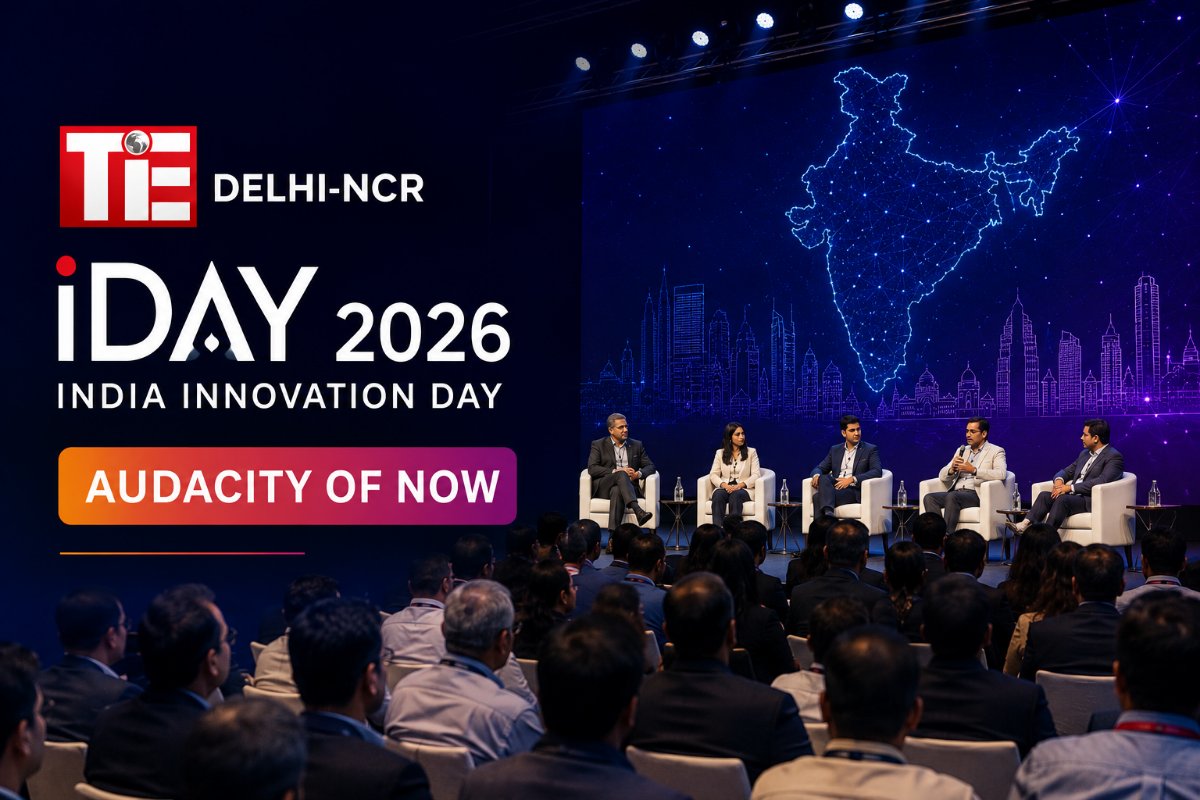
The 15th edition of iDay in Gurugram signalled a clear shift — from internet economy to innovation economy
There’s a moment when a country stops playing catch-up and starts setting the pace. That’s the thesis TiE Delhi-NCR put at the centre of India Innovation Day 2026 — and judging by the room, the ecosystem is starting to believe it.
The 15th edition of iDay, themed “Audacity of Now”, concluded in Gurugram this week, drawing more than 1,200 founders, investors, corporate leaders, policymakers, technologists, and ecosystem enablers for a day of conversations about where India’s innovation economy is headed — and what it will take to get there faster.
From Internet-First to Innovation-First
The event’s evolution is itself a signal. Formerly known as India Internet Day, the platform’s rebranding to India Innovation Day reflects a deliberate repositioning — the internet chapter is largely written, and the next one is being authored in labs, research institutions, and deep-tech startups building things the world hasn’t seen before.
Sessions across the day covered indigenous AI infrastructure, foundation and language models, AI-native companies, sovereign capabilities, public-private collaboration, quantum computing, biotech, space, D2C, and healthcare innovation. The breadth was intentional — India’s innovation story is no longer confined to one sector or one city.
Where the Real Action Was: TiE The Knot ?
The most watched segment of the day was TiE The Knot, now in its 14th edition — a live investment platform where early-stage startups pitch to investors in real time.
The numbers behind the format are worth noting. Across previous editions, 69 startups have pitched, with 31 receiving funding commitments worth over Rs 110 crore. That’s a conversion rate that most accelerator programmes would envy.
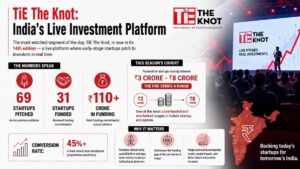
This season’s cohort focused on startups raising between Rs 3 crore and Rs 8 crore — the pre-Series A range that remains one of the most underfunded and overlooked stages in India’s startup ecosystem. Getting capital to companies at this stage, before they have the metrics to attract institutional attention, is genuinely valuable work.
AI Meets Cinema: Future Frames
A standout addition to this year’s programme was Future Frames — an AI film festival that brought together filmmakers, students, and technologists to explore what storytelling looks like when AI tools enter the creative process.
It was an unusual inclusion for a startup and innovation conference, but a fitting one. The question of how AI reshapes creative industries — not just enterprise workflows — is one that the broader ecosystem is only beginning to grapple with.
Why iDay Still Matters ?
India has no shortage of startup conferences. What distinguishes iDay is its consistency and its community. Fifteen editions in, it has built a track record as a platform where real conversations happen and real capital moves — not just panels where everyone agrees that India is doing well.
The “Audacity of Now” theme wasn’t accidental. It’s a provocation — a push against the institutional caution that often slows execution at exactly the moment opportunity is clearest. For an ecosystem increasingly confident in its own capabilities, it landed at the right time.