


The India AI opportunity 2026 is unlike anything this country’s technology ecosystem has seen before — and the clock for founders who want to be part of it is already ticking.
There is a moment in every major technology wave when the early movers are still early — but the window is beginning to close. Semiconductor founders who moved in the late 1980s built Intel-level businesses. Internet entrepreneurs who started in the mid-1990s built Google-level businesses. Mobile-first founders who moved between 2008 and 2012 built everything from Instagram to Flipkart.
India’s AI moment is right now. And according to the most comprehensive research on the subject published this year, the window is 2026 to 2027.
After that, the math gets harder. Not impossible — but significantly harder.
The Number That Changes Everything
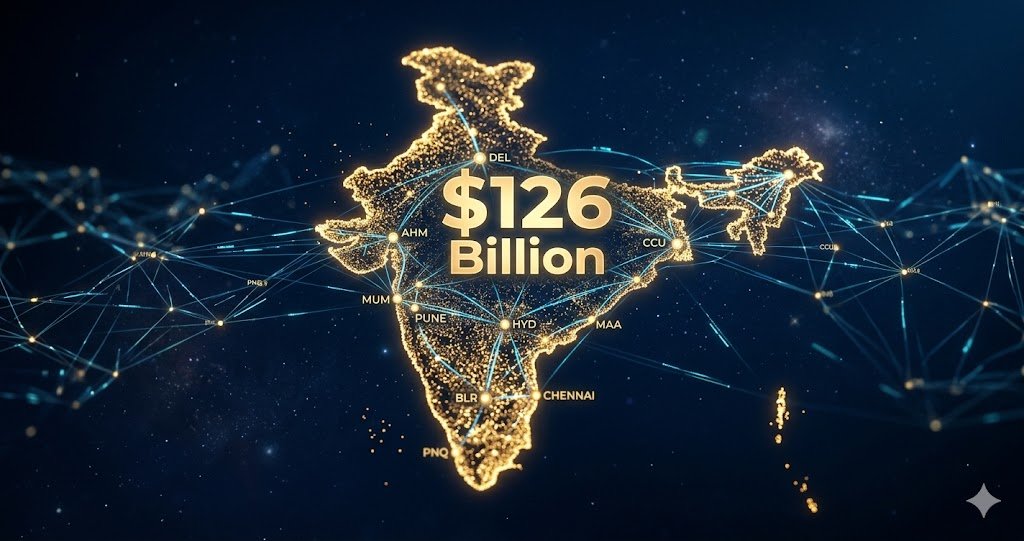
The India AI opportunity 2026 has a headline number — and it is striking. In January 2026, Google and Inc42 released the Bharat AI Startups Report 2026 — the most data-dense investigation into India’s artificial intelligence economy published to date. The number: India’s AI market is projected to reach $126 billion by 2030.
But the number that really matters is the one that comes after it.
By 2035, AI is expected to contribute $1.7 trillion to India’s GDP.
Let that sink in for a moment. A country that built its modern technology identity on software services exports — an industry that took three decades to cross $200 billion in annual revenue — is looking at a single technology wave contributing nearly ten times that amount to its economy within the next decade.
This is not speculation. This is research backed by Google, Inc42, the Indian government’s own data, and Stanford University, which ranked India among the world’s top three AI-competitive nations in its 2025 Global AI Vibrancy ranking.
The question is not whether India’s AI economy will be large. The question is: who builds it?
Four Forces Shaping the India AI Opportunity 2026
What makes 2026 genuinely different from the previous years of AI talk in India is that four forces — which normally arrive at different points in a technology cycle — are converging simultaneously.
Force 1: Demand has crossed the pilot stage.
For years, the story of AI in India was about potential. Proof-of-concept projects. Demo days. Pilot programmes that never went to production. That phase is ending.
Today, 87% of Indian enterprises are actively experimenting with AI — and nearly half are converting multiple pilots into live production deployments. Budgets are shifting from curiosity to outcomes. Enterprises are no longer buying AI as a feature. They are buying results: fewer fraud incidents, faster loan approvals, better diagnostics, lower compliance costs.
This is a fundamentally different kind of demand. It is repeat demand. It is defensible demand. And it is only going to grow.
Force 2: Government infrastructure is lowering the cost to build.
The IndiaAI Mission — backed by ₹10,300 crore from the central government — is doing something that no previous government initiative in Indian tech has done at this scale: directly subsidising the infrastructure cost of building AI companies.
Under the Mission, 38,000 GPUs have already been provisioned, with an additional 20,000 being added. High-end computing that would normally cost thousands of dollars per hour is available to Indian startups, researchers, and students at a subsidised rate of ₹65 per hour. That is not a rounding error. That is a structural advantage that genuinely changes the economics of building AI companies in India.
The AIKosh platform now hosts more than 5,500 datasets and 250-plus AI models spanning 20 sectors. Startups like Sarvam AI and BharatGen are building sovereign large language models for Indian languages. The infrastructure for a genuine, home-grown AI ecosystem is being assembled, piece by piece, with government money and global partnerships.
NVIDIA — the company whose chips power most of the world’s AI development — is directly collaborating with Indian providers including L&T and E2E Networks to build AI factories on Indian soil. L&T’s roadmap includes data centre facilities in Chennai and Mumbai, running on NVIDIA’s Blackwell GPU clusters. These are not announcements. They are construction projects.
Force 3: Capital is arriving with conviction.
In February 2026, India hosted the India AI Impact Summit — the first time this global gathering came to the Global South. The numbers from that summit were unlike anything India’s technology sector has seen before.
Over $200 billion in AI-related investment commitments were announced across the five-day event. To understand what that means: India’s entire cumulative startup funding since 2000 is somewhere in the same range. The summit generated, in five days, a commitment volume equivalent to two decades of startup investment.
The individual commitments paint the picture clearly. Reliance Industries pledged $110 billion over seven years towards AI-focused infrastructure. Adani Enterprises announced plans to invest $100 billion by 2035. Google’s Sundar Pichai announced a $15 billion AI hub in Visakhapatnam. General Catalyst committed $5 billion. Lightspeed Venture Partners committed $10 billion.
This capital does not exist in a vacuum. It creates data centres, which create compute access, which lowers the cost of building AI companies, which attracts more founders, which attracts more capital. The flywheel has started turning.
Force 4: Regulatory clarity is replacing uncertainty.
For the first time, Indian founders building AI companies know — broadly — what the rules are. The Digital Personal Data Protection Act is in place. NITI Aayog’s responsible AI guidelines are published. The India AI Impact Summit Declaration was endorsed by 92 countries and international organisations, signalling a global alignment on AI governance frameworks that India helped shape.
Founders who were holding back because they did not know what compliance would look like now have enough clarity to move.
The Enterprise vs Consumer Split — And Why Both Matter
The $126 billion opportunity is split into two distinct engines, and understanding them separately is important for any founder thinking about where to build.
Enterprise AI is where the money is concentrating fastest. Enterprise AI spending is expected to grow from $11 billion in 2025 to $71 billion by 2030 — a 6.4x expansion in five years. The driver is simple: enterprises are no longer experimenting. They are buying AI that reduces costs and improves operations at scale. India’s decades-long strength in enterprise software and IT services gives Indian founders a structural advantage here. The country has spent thirty years building the world’s back office. That muscle memory — understanding enterprise workflows, managing large implementations, navigating complex client requirements — translates directly into building AI products for enterprise buyers.
Consumer AI is where scale is already established — but monetisation is still being unlocked. India is already the world’s second-largest market for AI app downloads, with 177 million downloads in 2024. But total consumer AI app revenue in India sits at approximately $12 million — roughly $0.07 per download. That gap between distribution and monetisation is, depending on how you look at it, either a problem or the single biggest opportunity in Indian consumer tech.
The founders who figure out how to convert India’s massive, multilingual, mobile-first consumer base from free users to paying customers will build the consumer AI category leaders of this decade. It will not be easy. But the distribution is already there. The hard part — getting people to try AI — has largely been done.
Read : Semiconductor Startup HrdWyr Raises $13 Million to Build AI-Native Chips
The Clock Is Ticking — The India AI Opportunity 2026 Has a Deadline
The Bharat AI Startups Report makes a specific and striking claim about timing: 2026–2027 is the highest-leverage founding window for AI startups in India. The report says that entering after 2028 risks a 3–4x increase in customer acquisition costs as categories consolidate and user habits become entrenched.
This is not a marketing statement. It is a description of how technology markets work.
When a category is new, the first movers acquire users at low cost because there is no competition for attention. As the category matures, more players enter, advertising costs rise, brand switching costs increase, and the structural advantage flows to whoever got there first. The founders who built Swiggy and Zomato in the early 2010s paid almost nothing for their first million users. The founders trying to build a food delivery competitor in 2024 would pay an order of magnitude more for the same users.
The same dynamic is playing out in AI — but at a faster pace, because AI adoption is moving faster than food delivery, fintech, or e-commerce ever did.
89% of new startups launched in India last year used AI in their products or services. The window is not closing tomorrow. But it is closing.
What Survives at Bharat Scale
Here is something that sets India’s AI opportunity apart from what is happening in Silicon Valley, London, or Singapore: the stress test is harder.
India has 886 million internet users, 22 official languages, hundreds of local dialects, highly variable internet connectivity, and one of the most price-sensitive consumer markets in the world. When you build an AI product that works in India — really works, at scale, in multiple languages, on low-bandwidth connections, for users who do not default to English — you have built something that can work almost anywhere.
This is what the IndiaAI Mission CEO, Abhishek Singh, means when he talks about India’s role in Voice AI. “We will lead the world in voice AI,” he said ahead of the Summit. “For Indians, their voice will be the interface. Most global AI is built on English text. We are building AI on Indian voice data. If we can solve Voice as a Service — where a person can access the internet simply by speaking in Tamil or Bhojpuri — we create a template for the entire Global South.”
Sarvam AI is already doing this. The Bengaluru-based startup — selected by the government under the IndiaAI Mission to build India’s first homegrown sovereign large language model — has built Bulbul V3, a voice AI system that supports 35+ voices across 11 languages. Its Vision OCR system scored 84.3% on the olmOCR-Bench benchmark, outperforming both Google’s Gemini 3 Pro and OpenAI’s ChatGPT on multilingual document understanding.
Indian AI is not just serving India. It is beginning to outperform the best in the world on tasks that matter most for the world’s next billion users.
The Tier-2 City Question — Where MalikTimes Comes In
There is a part of this story that most national media consistently misses, partly because it is written from newsrooms in Bengaluru and Mumbai, and partly because it is more comfortable to cover the familiar names.
The next wave of Indian AI innovation is not going to come exclusively from Koramangala or Bandra Kurla Complex.
It is going to come from Lucknow, from Kanpur, from Indore, from Jaipur — and yes, from cities like Saharanpur, Uttar Pradesh, where the cost of living is lower, the talent is underutilised, and the problems to be solved are real, immediate, and unaddressed.
Uttar Pradesh alone now hosts over 18,500 recognised startups. Lucknow is home to roughly 1,700–1,800 active startups, supported by the StartInUP policy which offers seed funding, sustenance allowances, prototype funding, and plans for 100 incubators across the state. IIM Lucknow’s Enterprise Incubation Centre and IIT Kanpur’s incubation ecosystem are producing founders who are choosing to build locally rather than relocate to metros.
In February 2026, TiECon UP 2026 put Kanpur on India’s national startup map, bringing together top policymakers, investors, and founders to specifically address the entrepreneurial potential of Uttar Pradesh’s cities.
The pattern emerging in Tier-2 cities across India is consistent: lower operating costs, genuine local problems, untapped talent, and growing government support. For an AI startup, that combination is significant. You spend less on office space and salaries. You are closer to the real-world problem you are solving. And you are in a market where your product actually has to work — no amount of slick design can paper over a product that fails in Hindi or Bhojpuri.
The AI tools available today — APIs from OpenAI, Google, and Anthropic; open-source models from Meta and Mistral; compute access through IndiaAI Mission’s subsidised GPU grid — mean that a founder in Lucknow has access to the same building blocks as a founder in San Francisco. The infrastructure gap has largely closed.
What remains is the gap of ambition and awareness. And that is closing too.
The Honest Caveat — What India Still Needs to Figure Out
No honest piece about India’s AI opportunity would be complete without acknowledging the counterarguments, and they are real.
India largely missed the foundational LLM wave. OpenAI, Anthropic, Google DeepMind, and Meta built the foundation models that the world is now running on. India is working to build sovereign models through Sarvam AI and others, but the ₹10,300 crore IndiaAI Mission budget — while significant in Indian terms — is, as some analysts have pointed out, a fraction of what a single foundation model training run costs in the United States.
India’s AI opportunity in the near term is overwhelmingly at the application layer: using existing global models to build products and services that solve India-specific problems at India scale. That is a genuine and large opportunity — but it carries a dependency risk. We are, as one Inc42 analysis put it bluntly, “renting intelligence from American servers.”
The long-term answer to this is sovereign AI development — building Indian foundation models, trained on Indian data, hosted on Indian infrastructure, governed by Indian frameworks. That work is underway. It is early. And it needs more investment than it is currently receiving.
These are not reasons to be pessimistic. They are reasons to be clear-eyed. The $126 billion opportunity is real. The window is real. The risk is also real — and founders who understand it will build more defensible businesses than those who do not.
What the India AI Opportunity 2026 Means for Founders Building Today
If you are a founder sitting in Lucknow, Kanpur, Saharanpur, or any Tier-2 or Tier-3 city in India reading this piece, here is what the data says to you directly:
The infrastructure excuse is gone. The IndiaAI Mission’s subsidised GPU grid, the AIKosh datasets, and the global model APIs available at near-zero cost mean you can build a production-grade AI product without a large capital base. The excuse that you need to be in Bengaluru to access compute does not hold anymore.
The talent excuse is weakening. State-level incubators, IIM and IIT satellite programmes, and online learning have distributed AI talent more broadly than it was five years ago. You may not have a Stanford ML PhD next door — but you likely have undergraduate engineers who understand Python, can work with APIs, and can solve real problems if given the right direction.
The problem is in front of you. The most valuable AI applications being built in India right now are not clever academic exercises. They are products that solve specific, painful, real-world problems for people who do not have good solutions today. Those problems — in agriculture, healthcare, education, local commerce, financial access — are not concentrated in Bengaluru. They are concentrated in the cities and towns that most AI founders never think about.
The window is 2026–2027. After that, customer acquisition costs rise, categories consolidate, and the structural advantage flows to incumbents. The time to enter is before the market becomes crowded, not after.
The Bottom Line
The India AI opportunity 2026 is not a projection built on hope. It is built on four converging forces — demand, infrastructure, capital, and regulatory clarity — arriving simultaneously for the first time. India’s AI story is no longer a story about potential. It is a story about execution — who moves, how fast, and whether they build something that actually works at the scale and linguistic complexity that India demands.
The $126 billion market will be built by somebody. The $1.7 trillion GDP contribution will accrue to the economy of whoever builds it. The sovereign AI capability will belong to whichever startups invest in it now, while the cost is still manageable.
The question is simply whether Indian founders — including the ones building from cities that have been overlooked for three decades — are going to claim that opportunity, or watch someone else do it.
At MalikTimes, we are going to keep telling the stories of the founders who choose to claim it.
Key Data Points at a Glance
| Metric | Figure | Source |
|---|---|---|
| India AI market by 2030 | $126 billion | Google + Inc42 Bharat AI Startups Report 2026 |
| Projected GDP impact by 2035 | $1.7 trillion | Inc42, Government of India |
| Enterprise AI growth (2025–2030) | $11B → $71B | Bharat AI Startups Report 2026 |
| Consumer AI growth (2025–2030) | $13B → $55B | Bharat AI Startups Report 2026 |
| India’s AI app downloads (2024) | 177 million (Global #2) | Bharat AI Startups Report 2026 |
| Enterprises experimenting with AI | 87% | Inc42 Research |
| IndiaAI Mission budget | ₹10,300 crore | Ministry of Electronics & IT |
| GPUs provisioned under IndiaAI | 38,000+ (20,000 more coming) | India AI Impact Summit 2026 |
| GPU cost for startups | ₹65/hour | IndiaAI Mission |
| Investment commitments at Summit | $200 billion+ | India AI Impact Summit 2026 |
| Reliance AI infrastructure pledge | $110 billion over 7 years | India AI Impact Summit 2026 |
| Google AI hub in Visakhapatnam | $15 billion | Sundar Pichai, India AI Summit |
| UP startups (government recognised) | 18,500+ | Government of Uttar Pradesh |
| Lucknow active startups | 1,700–1,800 | StartInUP / Tracxn |
| India’s Global AI Rank (Stanford) | Top 3 | Stanford AI Vibrancy Index 2025 |
| New startups using AI (2025) | 89% | Central Chronicle / MeitY |
| Cost increase after 2028 (CAC) | 3–4x higher | Inc42 Bharat AI Report |
Further Reading
- Bharat AI Startups Report 2026 — Google x Inc42
- IndiaAI Mission — Official Portal
- India AI Impact Summit 2026 — PIB Press Release
- Why 2026–2027 Is a High-Leverage Window — Inc42
- Tier-2 Cities Powering India’s Startup Growth — AIM
MalikTimes is an independent publication covering startups, AI, funding, and business news — headquartered in Saharanpur, Uttar Pradesh, India. We cover the world from here.