



In a major development in India’s fintech ecosystem, Sumit Gwalani, the cofounder of Fi Money, has stepped down from the company after nearly six years. His exit comes at a time when the startup is facing financial challenges and undergoing a major business transformation.
Why Did Sumit Gwalani Quit Fi Money?
Announcing his exit on LinkedIn, Gwalani hinted at starting a new journey focused on Artificial Intelligence. He stated that his next venture will work on solving enterprise intelligence problems using AI.
His departure signals a turning point for Fi, which has been restructuring its operations amid slowing growth and rising financial pressure.
Fi Money’s Financial Struggles Explained
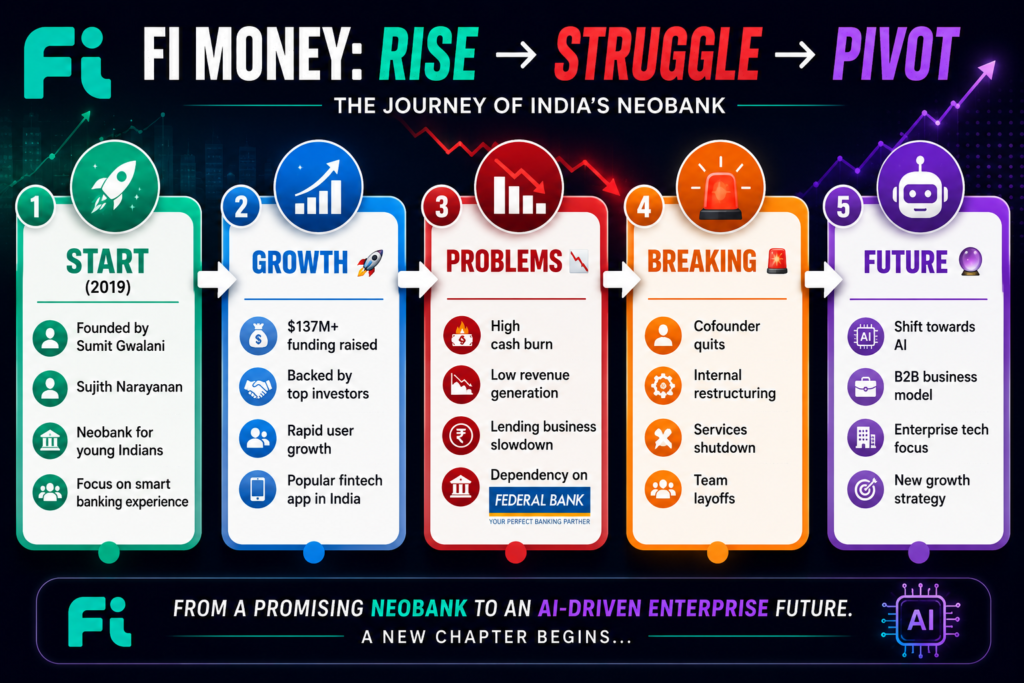
Founded in 2019 by former Google Pay executives Sujith Narayanan and Sumit Gwalani, Fi started as a digital-first neobank offering:
- Savings accounts
- Loans
- Investments
- Wealth management services
Despite raising over $137 million from investors like Peak XV, Ribbit Capital, and Alpha Wave Global, the startup has struggled to maintain growth momentum in recent years.
Key Challenges Faced by Fi:
- High cash burn and low monetisation
- Slow revenue growth
- Lending business slowdown
- Dependence on partner banks like Federal Bank
- No fresh funding in recent years
Business Pivot: From Consumer Banking to AI
Earlier this year, Fi announced a major shift in strategy. The company is moving away from consumer-focused banking services and entering the B2B AI and enterprise technology space.
As part of this transition:
- Some products are being discontinued
- Banking services on the Fi app were shut down
- The company is focusing on building AI-driven systems for businesses
According to cofounder Sujith Narayanan, this restructuring is necessary for the company’s long-term sustainability.
Bigger Problem in India’s Neobanking Sector
Fi’s struggles reflect a broader issue in India’s neobanking industry. Unlike traditional banks, neobanks cannot operate independently and must rely on licensed banks regulated by the Reserve Bank of India.
This dependency limits innovation and scalability.
Other players like Jupiter and Niyo are also facing similar structural challenges.
What’s Next for Sumit Gwalani?
As per his LinkedIn profile, Gwalani has already started working on a stealth AI startup since March. While details remain undisclosed, his focus is expected to be on enterprise AI solutions.
Final Takeaway
Fi Money’s journey highlights the challenges of building a sustainable neobanking business in India. With its pivot to AI and leadership changes, the coming months will be crucial in determining the startup’s future direction.
👤 Parvez Ali Advocate ✔️
📅 May 9, 2026
⏱️ Reading time: 5 minutes
🛡️ Reviewed by Editorial Team