


A new ICICI Securities report maps out where India’s online retail boom is heading — and who’s best positioned to ride it
India’s e-commerce story is no longer just about metros and millennials ordering gadgets. It’s about a kirana owner in Patna going digital, a first-time smartphone buyer in Rajkot shopping online, and a rural household in Madhya Pradesh receiving its first appliance delivery. The market is broadening — fast.
According to a new report by ICICI Securities, India’s e-commerce market is on track to nearly triple — from around $70 billion in FY25 to $174–214 billion by FY30 — driven by deeper internet penetration, expanding digital payments infrastructure, and surging demand from non-metro India.
From UPI to Quick Commerce: A Decade of Structural Shifts
The groundwork was laid well before anyone saw a pandemic coming. Post-2016, the rise of affordable smartphones, UPI-powered payments, and stronger last-mile logistics quietly rewired how Indians shop. Covid-19 then acted as an accelerant — particularly in groceries and essentials — pulling millions of first-time buyers online and keeping them there.
Today, India has nearly 970 million internet subscribers and around 500 million online shoppers. That base is still growing.
India’s E-Commerce’s Share of Retail Is Set to Double
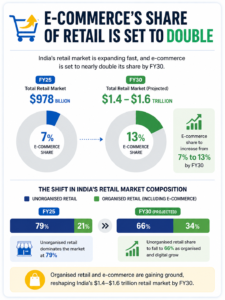
India’s total retail market stood at roughly $978 billion in FY25, with e-commerce accounting for just 7% of that. By FY30, as the overall retail pie expands to $1.4–1.6 trillion, e-commerce is expected to claim 13% of the market — nearly double its current share.
The shift isn’t just online versus offline. Unorganised retail, which currently makes up 79% of India’s retail market, is projected to fall to 66% by FY30 as organised and digital commerce continue gaining ground.
Rural India Will Drive More Than Half the Demand
Perhaps the most significant data point in the report: tier II–IV cities and rural regions are expected to contribute more than 60% of total e-commerce demand by 2026. This isn’t a distant forecast — it’s already happening, and it explains why every major platform is racing to crack the value-commerce and regional-language playbook.
Flipkart Leads — By a Considerable Margin
Among the big players, Flipkart sits comfortably at the top. The Walmart-owned platform commands an estimated 50–60% GMV market share and leads on monthly active users with 220–240 million. Its dominance is structural: smartphones, appliances, and electronics — categories where basket sizes are high — account for around 63–64% of its business. Add Ekart’s logistics depth, PhonePe’s payments reach, and a seller network of roughly 450,000 merchants, and the moat looks durable.
Amazon Holds Ground in Premium and FMCG
Amazon India, the second-largest player, holds an estimated 25–30% GMV share with around 150 million monthly active users. Its strength lies in metro markets and categories like beauty, personal care, and FMCG — areas where brand loyalty and repeat purchases matter. With over 180 million products across 100-plus categories and more than 100 fulfilment centres, Amazon isn’t ceding ground easily. Its push into quick commerce via Amazon Now signals it’s not playing defence either.
Meesho Owns the Value End — But Profitability Remains a Question
Meesho has done something genuinely impressive: it grew its share of India’s e-retail GMV from roughly 5% in 2021 to over 10% in 2025, now sitting at around 200 million monthly active users. It has essentially created a new category of online shoppers — price-sensitive buyers in smaller cities who weren’t being served by Flipkart or Amazon.
The challenge, as ICICI Securities notes, is unit economics. Low-ticket orders and relatively high delivery costs continue to make the path to profitability a complicated one.
Smartphones Still Rule, But White Goods Are Watching
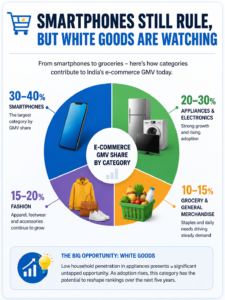
Smartphones remain the dominant category, accounting for 30–40% of total e-commerce GMV. Appliances and electronics follow at 20–30%, with fashion at 15–20% and grocery and general merchandise at 10–15%. The report flags low household penetration in appliances as a significant untapped opportunity — one that could reshape category rankings over the next five years.
Explore more insights on India’s ecommerce boom, digital retail trends, startup growth, and market reports shaping the future of online commerce.
Fact-checked by Malik Times Research
Disclaimer:-
This article is based on a report published by ICICI Securities. Data and
projections cited are sourced from the report and do not represent the editorial
views of this publication. Market forecasts are subject to change based on
evolving economic and regulatory conditions. Bareback Media has recently raised
funding from a group of investors who may be directly or indirectly associated
with companies we cover. This does not influence our reporting or editorial
decisions in any manner.