


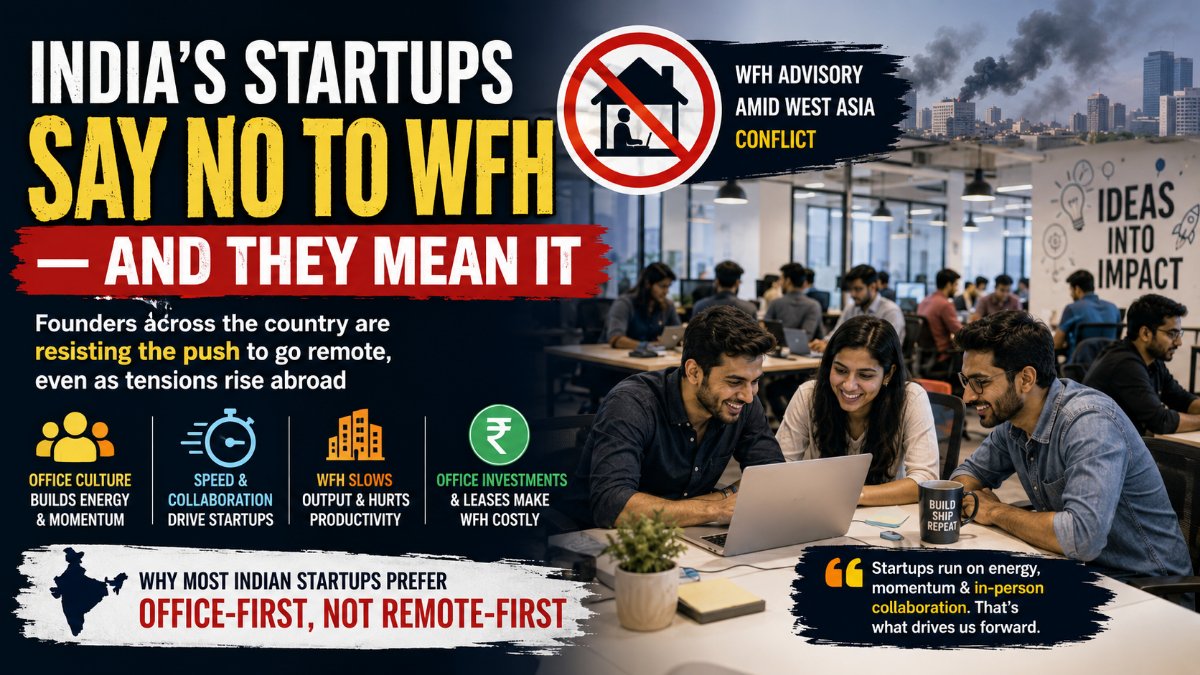
Founders across the country are resisting the push to go remote, even as tensions rise abroad
There is a certain kind of energy that exists only inside a startup office. It is the kind that cannot be manufactured on a video call or replicated through a flurry of Slack messages. India’s startup founders know this better than anyone — and right now, they are fighting hard to protect it.
Prime Minister Narendra Modi’s recent advisory encouraging businesses to explore work from home, in light of the escalating West Asia conflict, has stirred up conversations across India’s corporate landscape. Large IT companies are weighing their options. But walk into any startup in Bengaluru, Mumbai, or Delhi NCR, and you will find a very different mood — one of quiet resistance.
Most founders are not budging. And they have plenty of reasons why.
The Pandemic Left Scars That Founders Haven’t Forgotten
To understand why startups are so reluctant to go remote, you have to go back to 2020. When the pandemic forced offices to shut overnight, startups did what they always do — they adapted. But adapting came at a cost.
Teams that once moved at lightning speed suddenly found themselves stuck in calendar blocks and endless follow-up threads. Decisions that would have taken minutes in a room started taking days. The informal, high-energy culture that makes startups tick began to quietly fade.
“Startups run on energy and momentum. The moment WFH kicked in, we lost both,” recalled one SaaS founder, who chose not to be named. It is a sentiment that comes up again and again in conversations with founders. The pandemic was not just a disruption — for many, it was a painful lesson in how fragile startup culture can be.
An agritech founder based in Bengaluru described it plainly: “Output drops. Not immediately, but steadily. A couple of weeks in, and you can already feel the team losing its edge. We simply cannot let that happen again.”
Speed Is Everything — And Remote Work Slows Things Down
What sets a startup apart from a large corporation is not just its size. It is the speed at which it operates. Ideas turn into decisions. Decisions turn into action. And all of that happens fastest when people are in the same room.
A business leader at a marketplace startup described a scenario that many founders relate to: someone overhears a conversation in the hallway, connects two dots, and something gets built. That kind of spontaneous collaboration does not happen on a Zoom call. “The whole efficiency just evaporates when people go home,” they said.
For startups on a growth journey — racing against time, capital, and competition — even a few weeks of slower output can have consequences that echo for months.
Founders Believe WFH Impacts Productivity
One thing that does not get talked about enough is how difficult it was to bring employees back to the office after the pandemic. People had reshaped their lives around remote work. Shorter commutes, flexible hours, the comfort of home — these were not small things to give up.
Founders spent months coaxing, convincing, and in some cases negotiating with their teams to return. Office cultures that had been built over years had to be rebuilt almost from scratch. Many startups also made significant investments in making their offices better — more collaborative, more energising, more worth the commute.
The idea of undoing all of that for a temporary WFH arrangement is something most founders are simply not willing to consider. “We would still call people in to keep the momentum alive. In-person collaboration is non-negotiable for us,” said one founder firmly.
There is also a practical financial reality. A number of startups are tied to long-term office leases. Going remote does not mean the rent stops — it just means the office sits empty while the company simultaneously shoulders costs like WiFi allowances, remote equipment, and other work-from-home support expenses.
A Few Are Choosing Caution Over Convention
Not every startup is drawing the same hard line. Some are quietly building backup plans in case the geopolitical situation worsens. A founder based in Mumbai mentioned that non-essential travel has been put on hold while the team watches how things develop.
“We need a little more time before we commit to any policy change,”
they said.
Bengaluru-based Verloop.io has gone further, choosing to shift entirely to remote work as a safety-first measure.
“Our priority is keeping operations running smoothly while giving employees the freedom to work in a way that feels right for them,”
said CFO Ankit Sarawagi.
A founder running a venture studio shared that several startups in his portfolio are giving teams more flexibility right now — not because remote work is more productive, but because keeping good people matters more than anything else at this moment. “People are the engine. Everything else is secondary,” he said.
The Office Stays Open
When you step back and look at the full picture, the startup ecosystem’s position is firm. Remote work had its moment. Most founders lived through it, learned from it, and moved on. They rebuilt their teams, their cultures, and their offices — and they are not about to let a geopolitical advisory undo all of that.
A few will go remote. Some will find a middle path. But the overwhelming majority of India’s startup founders are keeping their office doors open — because for them, that is where the real work gets done.
Published By: Malik Times Editorial Network
 Content Verified
Fact-checked by Malik Times Research