


India may soon witness the return of Chinese funding into its startup ecosystem after the Union Cabinet approved key amendments to the country’s foreign direct investment (FDI) policy for nations sharing land borders with India, including China.
The decision, approved during a Cabinet meeting chaired by Prime Minister Narendra Modi, is expected to provide relief to startups and deep-tech companies that have struggled to raise capital under the stricter investment rules introduced in 2020.
What Has Changed in the FDI Policy?
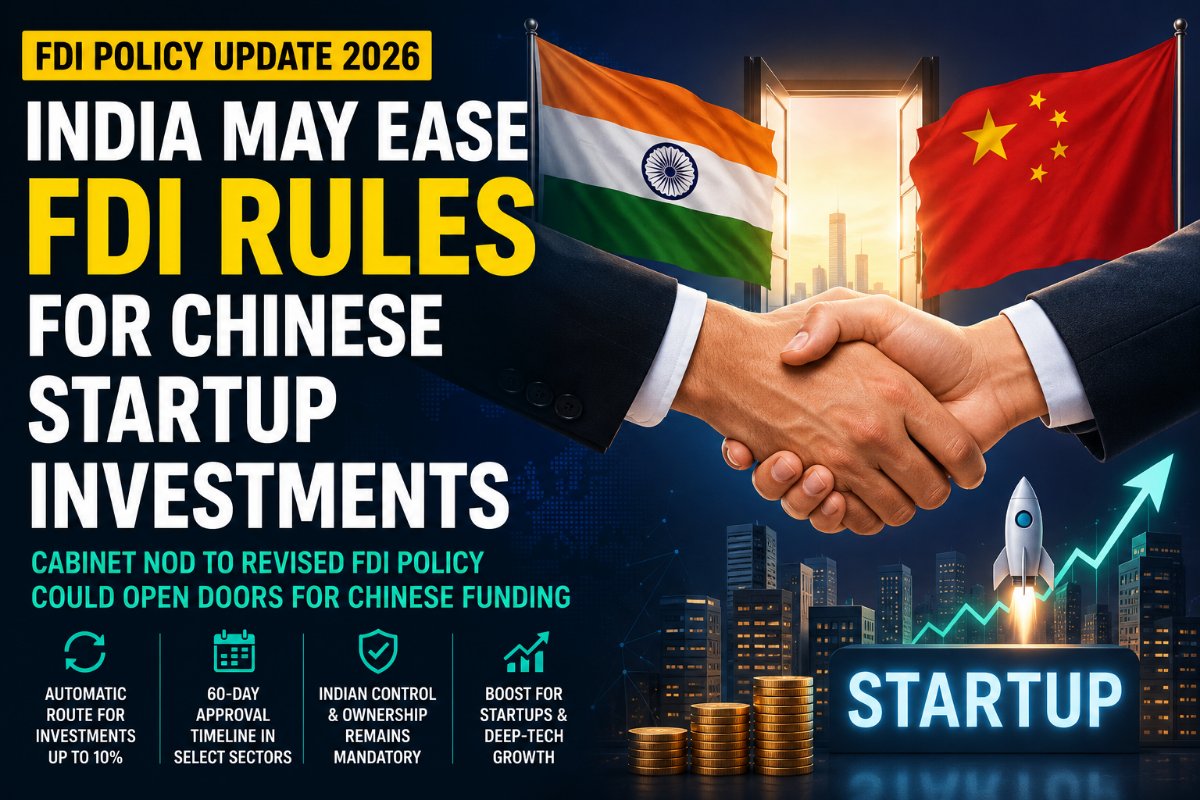
Under the revised framework, foreign investors from neighbouring countries will now be allowed to invest through the automatic route if their stake remains below 10% and does not involve controlling ownership.
Earlier, investments from countries sharing land borders with India required mandatory government approval under Press Note 3 (2020), even for relatively small investments.
The updated policy is expected to simplify fundraising for Indian startups, especially those seeking capital from global venture capital and private equity funds with Chinese participation.
However, the government has clarified that majority ownership and operational control of Indian companies must continue to remain with Indian citizens or Indian-controlled entities.
Relief for Startups and Deep-Tech Companies
The earlier restrictions had created significant hurdles for startups raising funds, particularly in sectors such as fintech, AI, deep-tech, electronics, and manufacturing.
Many startups faced long approval delays whenever an investment involved entities connected to neighbouring countries like China.
Industry experts believe the revised rules could improve capital availability at a time when startup funding has slowed globally and companies are increasingly focusing on sustainable growth.
The government has also introduced a faster approval timeline of 60 days for investments in select manufacturing sectors including:
- Electronic components
- Capital goods
- Polysilicon manufacturing
- Ingot and wafer manufacturing
The approved sector list may be updated further by the Committee of Secretaries.
Why Press Note 3 Was Introduced
India introduced Press Note 3 in April 2020 during the COVID-19 pandemic to prevent opportunistic acquisitions of Indian companies when markets were under pressure.
The policy became even more significant after tensions between India and China escalated following the 2020–2021 China–India skirmishes.
Following the border conflict, India imposed stricter scrutiny on Chinese investments and banned more than 200 Chinese apps, including TikTok, WeChat, and UC Browser.
As a result, Chinese investments into Indian startups declined sharply over the last few years.
Chinese Investors Could Return to Indian Startups
Before the restrictions were introduced, Chinese investors played a major role in India’s startup ecosystem, backing several large technology companies across ecommerce, fintech, food delivery, gaming, and mobility sectors.
The latest policy changes are likely to revive investor interest from Chinese venture capital firms and large technology conglomerates looking to re-enter India’s rapidly growing digital economy.
However, it remains unclear whether Chinese consumer internet companies and apps previously banned in India will be allowed to resume operations in the country.
Indian startups have been facing funding challenges over the last few years, especially amid changing investor sentiment and tighter regulations. Recently, several startups also witnessed major executive reshuffles across the ecosystem.
The revised FDI framework signals a more balanced approach from the Indian government — one that attempts to protect national security interests while also supporting innovation, manufacturing, and startup growth.
For Indian startups facing tighter funding conditions, the easing of investment rules could open up a fresh source of global capital and boost confidence across the broader technology ecosystem.
By MalikTimes News Desk
Fact-Checked & Verified by MalikTimes Editorial Team
Last Updated: 12 May 2026